


Introducing the research findings of the Institute of Economic Sciences to the Tobacco Administration
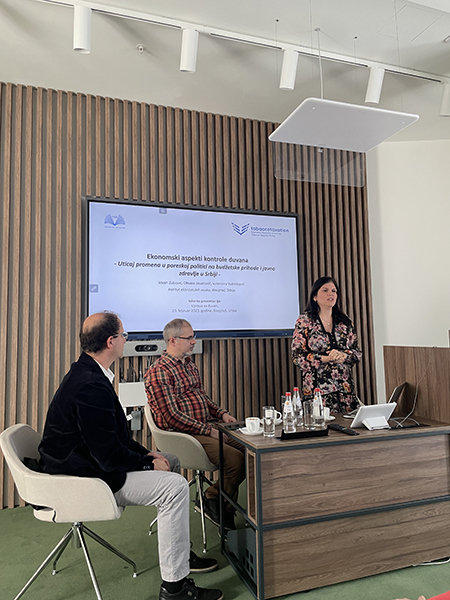
On February 20, 2024, the Institute of Economic Sciences (IES) researchers held a presentation at the Tobacco Administration and presented the latest research results conducted in 2023. The meeting was opened with an introductory speech by the director of IES and the project leader of "Accelerating Progress on Effective Tobacco Tax Policies in Low and Middle-Income Countries," Dr. Jovan Zubović.
Dr. Olivera Jovanović presented the results of the impact of tobacco tax increases on tax revenues and public health in Serbia. The results showed that increasing the specific excise tax in Serbia by 15% annually would result in higher tobacco excise tax revenues in the projected years. The benefits for public health would be positive as it would reduce the number of premature deaths.
Some of the key recommendations for policymakers are:
- The government should consider increasing the specific excise tax by at least 15%, resulting in higher total tobacco excise revenues and overall budget revenues.
- The government should consider improving tobacco tax policy through its economic impact, as it will have positive effects on smoking cessation and preventing youth smoking initiation, thus saving lives and improving the quality of life in Serbia.
Dr. Aleksandar Zdravković presented the results of research on the macroeconomic impact of tobacco taxation on poverty and inequality in Serbia.
The research results indicate that although the cost of cigarettes is regressive (higher among lower-income populations compared to higher-income populations), additional taxation of cigarettes has a progressive effect (reducing inequality in favor of lower-income households), regardless of the level of tax rate change.
Additional taxation of tobacco products increases the risk of poverty, but the estimated increase in the relative poverty rate is small, ranging between 0.5 (25% increase in specific excise tax) and 1 (50% increase) percentage points for the scenarios examined. This increase can be significantly reduced or completely neutralized through a revenue-neutral tax reform, where additional revenue is used to subsidize other products and services.




- Zmaj Jovina 12, 11000 Belgrade, Serbia
- Phone: + 381 11 2623 055, + 381 11 2622 357
- Fax: + 381 11 2181 471
- Email: office@ien.bg.ac.rs
- Activity Code: 7220
- PIB: 100039204
- Identification number: 07041144


